
There is a practical problem behind HelminthixDB: far more potentially useful information is published than any person can continuously read, interpret, standardise and enter into a structured database. A newspaper article, press release or scientific paper might contain one important piece of information: a new compound being tested against a parasite, a potential drug target, a diagnostic marker, an emerging resistance mechanism, or a newly reported species–disease relationship.
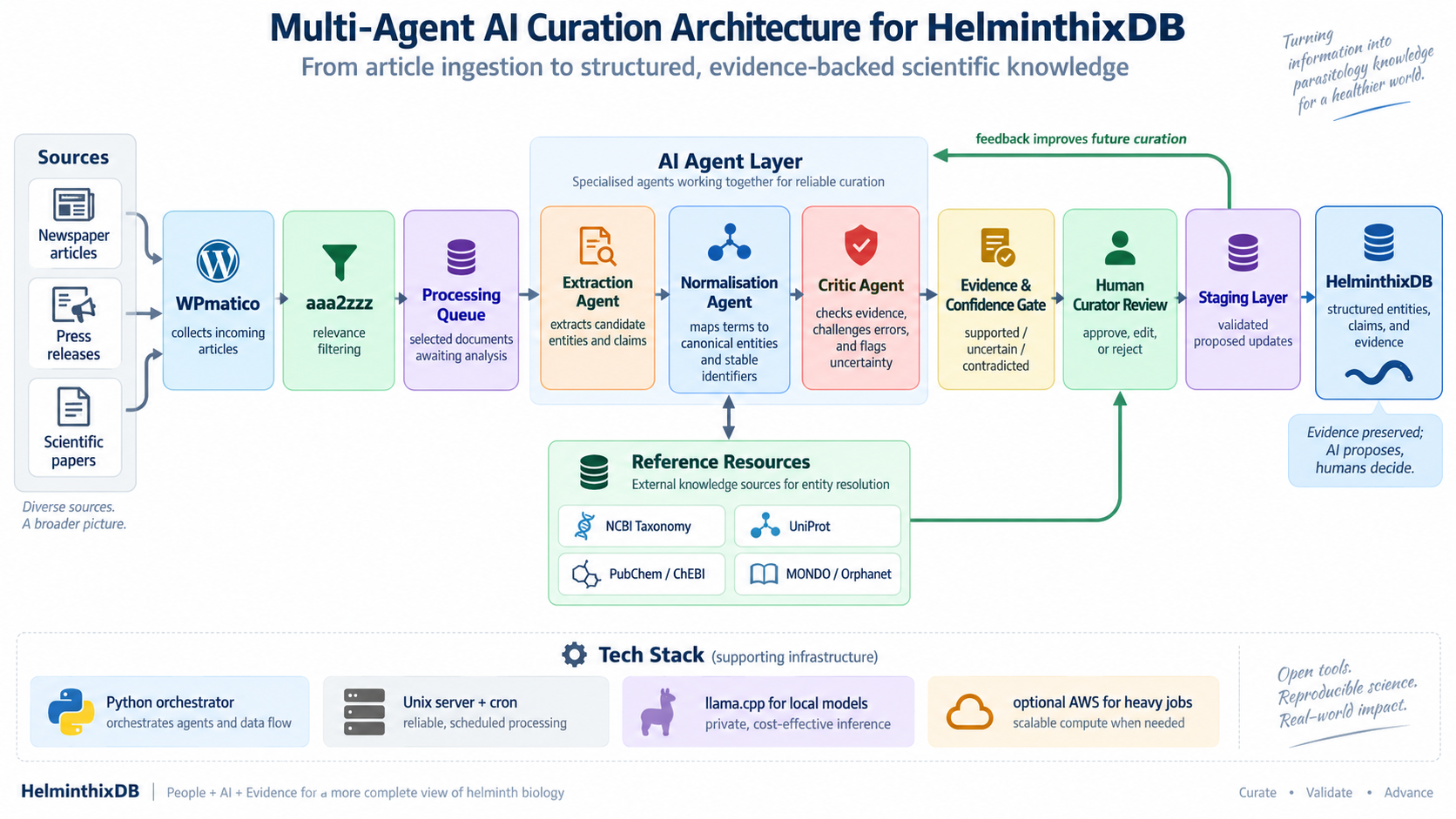
For Helminthix, finding the documents is already partly solved. WPmatico collects articles into WordPress, while my own aaa2zzz plugin filters them for likely relevance. The harder problem comes afterwards:
How do we turn unstructured text written for humans into accurate, standardised and traceable scientific knowledge?
Biomedical databases have faced this problem for decades. Systems such as PubTator automatically identify biomedical concepts in the scientific literature, while Textpresso Central combines text mining with tools for human curation (Wei et al., 2013; Müller et al., 2018). More recently, work on AI-assisted biocuration has increasingly emphasised human-in-the-loop systems, where automation handles repetitive work while expert curators remain responsible for scientific judgement (Wood et al., 2026). For HelminthixDB, I think a multi-agent architecture would work particularly well.
First: what kind of environment are the agents operating in?
Russell and Norvig define an agent as something that perceives its environment through sensors and acts upon it through actuators. More importantly, they argue that the design of an agent should depend on the nature of the environment in which it operates (Russell & Norvig, 2021). The HelminthixDB curation environment is difficult: it is partially observable, because one article rarely contains the complete scientific picture; it is dynamic, because new information is continuously published; it is sequential, because an error made during extraction can affect later normalisation and interpretation; and it is also uncertain, because later studies may contradict an earlier result.
That makes a single instruction such as “read this article and update the database” a poor design. Instead, I would divide the problem between three agents.
Agent 1: the Extraction Agent
The Extraction Agent asks:
What does this article actually claim?
It identifies relevant entities such as parasite species, diseases, drugs, compounds, genes, proteins, targets, pathways, diagnostic methods, resistance mechanisms and clinical trials. But simply recognising names is not enough: what HelminthixDB needs is the relationship between them. For example, finding the words praziquantel, Schistosoma mansoni and TRPM_PZQ is less useful than extracting the claim that praziquantel acts through a particular target in S. mansoni. The agent should also retain the exact supporting text, source and publication date.
For this agent, the performance measure should favour sensitivity: missing an important relationship is more costly than sending an occasional irrelevant candidate to the next stage. This resembles the approach behind PubTator, which uses automated concept recognition to reduce the amount of literature that human curators must process manually (Wei et al., 2019).
Agent 2: the Normalisation Agent
The Normalisation Agent has a different problem:
What exactly does this entity refer to?
This may actually be the harder task. Scientific names are notoriously inconsistent: Schistosoma mansoni may appear as S. mansoni; compounds can have generic names, development codes, chemical names and brand names; and genes and proteins accumulate aliases and historical names, sometimes differing between species.
The Normalisation Agent therefore needs to map extracted concepts onto canonical records using resources such as NCBI Taxonomy, UniProt, PubChem, ChEBI, MONDO and Orphanet. Here the performance measure should favour precision: creating a duplicate entry is inconvenient, but incorrectly merging two different genes, proteins or compounds could damage the integrity of the database.
Keeping extraction and normalisation as separate agents also makes errors easier to understand, since we can ask separately whether the first agent understood the article and whether the second agent identified the correct biological entity. This follows an important principle from AIMA: a rational agent can only perform well if its performance measure reflects what we actually want, since optimising the wrong objective can produce perfectly efficient but completely undesirable behaviour (Russell & Norvig, 2021).
Agent 3: the Critic
The third agent has an intentionally different role: its job is to find what the other agents got wrong. The Critic receives the original source together with the proposed claim and normalised entities, and asks whether the evidence really supports the interpretation.
Was the target experimentally demonstrated or merely predicted? Was the experiment in vitro, in an animal model or in humans? Has an association accidentally become a causal claim? Did the Normalisation Agent select the correct species or protein?
This is surprisingly close to the critic in Russell and Norvig’s learning-agent architecture: a component that evaluates performance against an external standard rather than allowing the acting component to judge its own success (Russell & Norvig, 2021). In other words, the Extraction Agent should not be allowed to mark its own homework.
Store evidence, not just conclusions
Another important principle is that HelminthixDB should distinguish between entities, claims and evidence. A newspaper article reporting that a compound kills a parasite should not automatically become a statement of scientific truth. Instead, HelminthixDB should record that a particular source made a particular claim, since a later scientific paper, clinical trial or regulatory decision may strengthen, qualify or contradict it.
This idea already appears in established biological knowledgebases. CIViC, for example, separates individual evidence records from higher-level clinical assertions and requires expert moderation (Danos et al., 2019). The Gene Ontology Causal Activity Modeling (GO-CAM) framework similarly represents biological knowledge as interconnected activities and relationships rather than isolated annotations, an approach Chris Mungall and colleagues were instrumental in developing (Thomas et al., 2019). That kind of provenance is exactly what HelminthixDB will need.
Humans remain the final decision-makers
Initially, new entities and uncertain claims should enter a staging area rather than the production database, where a human curator can see the source, proposed relationship, normalised entities and the Critic’s assessment, and decide whether to approve, edit or reject the proposal.
Those decisions also become useful feedback: over time, they can be used to improve all three agents. The goal is therefore not to eliminate human curation but to concentrate human effort on the decisions where expertise actually matters.
A relatively simple technical stack
The implementation does not need to depend on expensive commercial AI APIs. WPmatico and aaa2zzz can continue handling collection and relevance filtering, while a Python application running on the existing Unix server manages the processing queue, queries reference databases, validates outputs and communicates with HelminthixDB.
For routine language-model work, I would start with a small open-weight model running locally through llama.cpp; most identifier matching, duplicate detection and validation should use conventional software rather than generative AI. If an unusually difficult document requires more memory or processing power than the web server can provide, that individual task could be sent temporarily to AWS, processed there, and returned, so cloud compute remains the exception rather than the default.
The overall workflow is simple: articles are collected and filtered, one agent extracts scientific claims, another resolves the entities, a third challenges the interpretation, and a human curator makes the final decision before anything enters HelminthixDB.
The aim is not to create an autonomous artificial scientist. It is something rather more practical:
A team of artificial scientific curators that can read continuously, extract systematically, standardise carefully and challenge each other’s conclusions, while keeping the evidence visible and leaving final scientific judgement with humans.
Implementation recipe
None of this needs to be exotic. Here is the stack I would actually reach for, agent by agent.
Core stack
Runtime: Python 3.11/3.12
Packages: sqlalchemy, pymysql, pydantic, requests, httpx, python-dotenv, tenacity, orjson, loguru, typer, pandas
Use for: database access, schemas, HTTP calls, configuration, retries, JSON, logging, CLI jobs, occasional curation/export work
Local LLM layer
Packages: llama-cpp-python
Use for: Extraction Agent, Normalisation Agent reasoning, Critic Agent, local inference with quantised GGUF models
Biomedical NLP
Packages: spacy, scispacy
Models: en_core_sci_sm, optionally en_ner_bionlp13cg_md, en_ner_bc5cdr_md
Use for: entity spotting, candidate genes/proteins, chemicals, diseases, species, reducing LLM workload
Entity normalisation
Packages: rapidfuzz, diskcache
Use for: synonym matching, fuzzy entity resolution, cached lookups, matching extracted terms to HelminthixDB and reference vocabularies
External reference resources
Sources: NCBI Taxonomy, UniProt, PubChem, ChEBI, MONDO, Orphanet
Use for: canonical names, stable identifiers, aliases, species resolution, drugs/compounds, genes/proteins, diseases
Web/source handling
Packages: feedparser, beautifulsoup4, lxml
Use for: article metadata, source-page parsing, supporting-paper lookup, feeds if needed beyond WordPress
Structured agent outputs
Packages: pydantic
Schemas: ArticleInput, ExtractedEntity, ExtractedClaim, NormalisedEntity, CriticVerdict, CuratorDecision
Use for: strict JSON validation, rejecting malformed agent output, stable handoff between agents
Database
Backend: MariaDB/MySQL via sqlalchemy + pymysql
Tables: articles, processing_queue, entity_candidates, claim_candidates, normalised_entities, critic_reviews, staging_entities, staging_claims, curator_actions, later entities, claims, evidence
Use for: processing state, provenance, staging, curator decisions, final HelminthixDB records
Extraction Agent
Packages: llama-cpp-python, scispacy, pydantic
Use for: identify entities, extract scientific claims, capture supporting sentences, return structured JSON
Normalisation Agent
Packages: rapidfuzz, requests, diskcache, optionally llama-cpp-python
Use for: canonicalise names, resolve aliases, map to NCBI/UniProt/PubChem/ChEBI/MONDO IDs, detect new vs existing entities
Critic Agent
Packages: llama-cpp-python, pydantic
Use for: verify claims against source text, detect association-vs-causation errors, predicted-vs-demonstrated claims, species/context mistakes, assign supported/uncertain/contradicted status
Orchestration
Packages: sqlalchemy, tenacity, loguru, typer
Use for: queue management, agent sequencing, retries, error handling, job logging, cron entry points
Human review UI
Packages: fastapi, uvicorn, jinja2, optionally sqladmin
Use for: approve/edit/reject interface, inspect evidence, review critic verdicts, move approved records into staging/final HelminthixDB
Server/scheduling
Infrastructure: Unix host, cron, Python virtual environment
Use for: scheduled processing, queue polling, local inference, routine database work
Heavy-job fallback
Infrastructure: AWS EC2 or similar temporary compute
Use for: larger models, unusually difficult documents, occasional batch processing, jobs exceeding local RAM/CPU
References
Danos, A.M., Krysiak, K., Barnell, E.K., et al. (2019). Standard operating procedure for curation and clinical interpretation of variants in cancer. Genome Medicine, 11, 76. doi:10.1186/s13073-019-0687-x.
Müller, H.-M., Van Auken, K.M., Li, Y. & Sternberg, P.W. (2018). Textpresso Central: a customizable platform for searching, text mining, viewing, and curating biomedical literature. BMC Bioinformatics, 19, 94. doi:10.1186/s12859-018-2103-8.
Russell, S.J. & Norvig, P. (2021). Artificial Intelligence: A Modern Approach, 4th ed. Pearson.
Thomas, P.D., Hill, D.P., Mi, H., Osumi-Sutherland, D., Van Auken, K., Carbon, S., Balhoff, J.P., Albou, L.-P., Good, B., Gaudet, P., Lewis, S.E. & Mungall, C.J. (2019). Gene Ontology Causal Activity Modeling (GO-CAM) moves beyond GO annotations to structured descriptions of biological functions and systems. Nature Genetics, 51, 1429–1433. doi:10.1038/s41588-019-0500-1.
Wei, C.-H., Kao, H.-Y. & Lu, Z. (2013). PubTator: a web-based text mining tool for assisting biocuration. Nucleic Acids Research, 41(W1), W518–W522. doi:10.1093/nar/gkt441.
Wei, C.-H., Allot, A., Leaman, R. & Lu, Z. (2019). PubTator Central: automated concept annotation for biomedical full text articles. Nucleic Acids Research, 47(W1), W587–W593. doi:10.1093/nar/gkz389.
Wood, V., et al. (2026). Empowering biological knowledgebases: advances in human-in-the-loop AI-driven literature curation. Bioinformatics Advances, 6(1), vbag028. doi:10.1093/bioadv/vbag028.